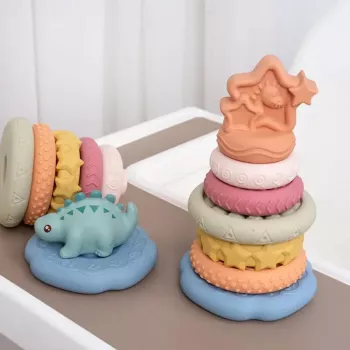
This 7-piece stacking set pairs classic hands-on learning with a cheerful dinosaur squeeze toy, making it an easy pick for birthdays, baby showers, and everyday play. Simple shapes, repeatable actions, and open-ended activities help babies and toddlers practice early problem-solving while having fun.
Made for little hands and short, repeatable play cycles, this set keeps the setup simple while offering more than one way to play.
If you’re looking for a practical toy that still feels special to unwrap, the 7-Piece Montessori Stacking Baby Toy Set with Dinosaur Squeeze Toy – Perfect Gift for Boys and Girls keeps things cheerful, hands-on, and easy to revisit day after day.
Stacking toys fit naturally into Montessori-style play because the goal is clear, the materials do the teaching, and kids can repeat the same action until it “clicks.” Instead of flashy sounds or complicated rules, stacking invites children to test an idea, adjust, and try again.
For a quick refresher on core Montessori concepts—like independence, repetition, and hands-on discovery—see the American Montessori Society’s introduction to Montessori.
Sometimes a child wants to participate but isn’t in the mood to stack “the right way.” That’s where the dinosaur squeeze toy shines: it’s a simple, satisfying action that still supports development.
A helpful approach is to keep the dinosaur nearby as a “reset tool.” If stacking becomes frustrating, a few squeezes can help little hands settle, then the child can return to the tower when ready.
This set can grow with your child because the same pieces support different goals at different ages—from exploring with the hands to purposeful building and simple games.
| Stage | Skills to Practice | Try This Activity | Adult Tip |
|---|---|---|---|
| 6–12 months (supervised) | Grasping, transferring, sensory exploration | Offer one piece at a time; let baby tap, hold, and explore | Keep sessions short and rotate pieces to maintain interest |
| 12–18 months | Cause-and-effect, early stacking, focus | Stack 2–3 pieces; celebrate effort; let child knock down safely | Model slowly, then pause to let the child try |
| 18–36 months | Problem-solving, sequencing, fine motor control | Challenge: build tallest tower; sort pieces by size before stacking | Use simple prompts like “Which one is bigger?” |
| 3+ years (with supervision) | Imaginative play, storytelling, cooperation | Create a “dinosaur home” and build structures with the stack pieces | Encourage turn-taking and describing what they built |
Hands-on toys get handled, dropped, and (especially for babies) explored with the mouth. A simple routine helps keep play safe and consistent.
For broader guidance on choosing and maintaining safe toys, the American Academy of Pediatrics toy safety page and the U.S. Consumer Product Safety Commission toy safety resources are both solid references.
This is the kind of present that feels fun right away, but also earns a permanent spot in the play rotation because it meets kids where they are.
For a parent-friendly add-on that supports calmer evenings (especially helpful when the day has been full of big toddler energy), consider pairing the toy with Sleepytime Success: The Ultimate Bedtime Routine Checklist for Kids to help make transitions smoother.
It’s a strong fit from baby through toddler stages: younger babies can explore with supervised grasping and holding, while older babies and toddlers can practice purposeful stacking, sorting by size, and simple problem-solving. Close supervision is especially important during mouthing phases.
Place a few pieces at a time on a small tray or mat, demonstrate one slow stack, and then let your child repeat independently without lots of corrections. Keeping the setup uncluttered helps children focus and choose their own pace.
Follow the seller or manufacturer’s care guidance; when mild soap and water are appropriate, clean gently and fully dry before putting pieces away. Store the full set together and inspect regularly so worn or damaged parts are removed right away.





Leave a comment