Jaw tightness can quietly drive headaches, facial soreness, ear pressure, and neck pain—especially when clenching or grinding becomes a daily habit. Stress, posture, sleep disruption, long screen sessions, and even dental changes can all nudge the jaw into a “braced” state. The good news: small, repeatable habits can lower tension, reduce head-pain triggers, and support comfort over time.
The temporomandibular joint (TMJ) and the muscles around it don’t work in isolation. The jaw shares nerve pathways with the temples, cheeks, and forehead, so irritated or overworked jaw muscles can be perceived as head pain rather than “jaw pain.” Clenching and bracing overload the masseter and temporalis muscles, and that strain can refer upward—often into the temples or behind the eyes.
Jaw tension can also make common headache triggers hit harder. Poor sleep, dehydration, and stress may already raise sensitivity; adding constant jaw muscle guarding can make episodes feel more frequent or stubborn. Beyond pain, watch for jaw fatigue when chewing, clicking or popping, limited opening, morning soreness, tooth sensitivity, or “full” ears without an infection.
Many people aren’t aware their teeth are touching during focus-heavy tasks—work, driving, workouts, or scrolling. Even light, sustained contact can keep jaw muscles “on” for hours.
Grinding and clenching during sleep are commonly linked with stress and sleep disruption, and sometimes with airway issues. Morning headaches, jaw stiffness, and sore teeth can be clues.
Forward head posture increases load through the neck and jaw. A laptop or phone held low can lock this posture in place, reinforcing tension through the temples, jaw, and upper shoulders.
Frequent gum chewing, tough foods, nail biting, or resting the chin on the hand can aggravate already-irritated tissues—especially during a flare.
Recent dental work, uneven contacts, or missing teeth may contribute for some people. Persistent pain is worth a dental evaluation, particularly if tooth sensitivity or wear is increasing. For additional background on TMJ-related problems, see the NIH National Institute of Dental and Craniofacial Research overview of TMD and the Mayo Clinic guide to TMJ disorders.
Jaw-related headaches often follow patterns. Timing clues include pain that’s worse in the morning, after long meetings, after stressful tasks, or after chewing. Location clues include the temples, behind the eyes, the jaw angle, cheekbones, the ear area, and the base of the skull.
A gentle touch test can help: lightly press the temples or jaw muscles and see whether it reproduces familiar headache discomfort (avoid aggressive pressure). Movement clues also matter—discomfort that rises with wide yawns, chewing, or prolonged talking, or a jaw opening that feels uneven or limited.
| Pattern | Common feel | Typical clues | First steps to try |
|---|---|---|---|
| Jaw-related muscle strain | Pressure/ache in temples, cheeks, behind eyes | Worse with clenching/chewing; morning soreness; tender jaw muscles | Jaw relaxation cues, warm compress, gentle stretching, limit chewing overload |
| Tension-type headache | Band-like tightness across forehead/occiput | Stress, long screen time, neck tightness | Breaks, posture reset, hydration, neck/shoulder mobility |
| Migraine | Throbbing or pulsating; may be one-sided | Nausea, light/sound sensitivity, activity worsens pain | Trigger tracking, sleep regularity, medical guidance; jaw care can reduce overlap |
| Sinus-related pain | Pressure in face/forehead | Congestion, worsens with bending forward; fever sometimes | Treat congestion; medical evaluation if severe/persistent |
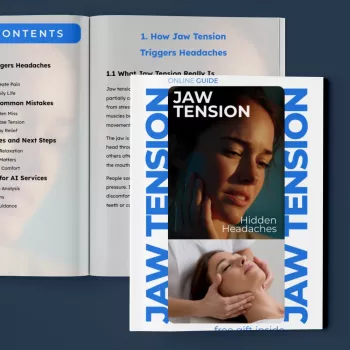
For a structured approach with checklists and step-by-step routines, consider Jaw Tension, Hidden Headaches – A Practical Guide to Jaw Tension and Headaches Relief, Awareness, and Daily Comfort.
If daytime clenching rises with overcommitment and constant urgency, building better boundaries can indirectly reduce jaw bracing during the workday. Not Right Now Doesn’t Mean Never: AI-Powered Checklist for How to Use AI to Say No to Extra Work, Protect Your Time, and Set Boundaries can help create scripts and systems to reduce stress spikes.
Because poor sleep can reinforce nighttime clenching and morning headaches, a predictable evening wind-down can support recovery—especially for families balancing busy schedules. Sleepytime Success: The Ultimate Bedtime Routine Checklist for Kids offers a ready-to-use routine framework.
Yes. Overworked jaw and temple muscles can refer pain into the temples and behind the eyes through shared nerve pathways, and this can overlap with other headache types. If symptoms are severe, changing, or paired with neurologic signs, seek medical evaluation.
Use a repeatable cue: lips together, teeth apart, tongue relaxed, and shoulders down. Pair it with reminders every 60–90 minutes, add brief posture resets, and use slow exhales to reduce bracing—then repeat until it becomes automatic.
Often, yes—especially for protecting teeth, and it may reduce muscle load for some people. Over-the-counter guards can be a short-term option, but a dentist-guided fit is safer and more comfortable when symptoms persist or tooth wear is present.






Leave a comment