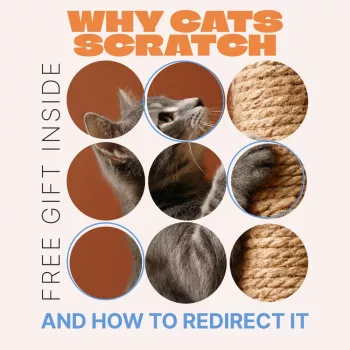
Why Cats Scratch Furniture—and How to Redirect the Habit Without a Battle
Scratching is a normal cat behavior that serves multiple needs: body care, communication, emotional regulation, and territory marking. The goal isn’t to eliminate scratching—it’s to move it to places that work for both cat and home. Below are the most common reasons cats scratch furniture, how to set up irresistible alternatives, and how to reinforce the right choice consistently.
What Scratching Does for a Cat (And Why It’s Not “Bad Behavior”)
Scratching is part maintenance, part messaging, and part emotional outlet. When a cat chooses the couch, they aren’t being “spiteful”—they’re meeting real needs with the best tool available.
- Claw maintenance: scratching helps remove the outer claw sheath and keeps claws functional.
- Full-body stretch: many cats scratch after waking or during transitions to loosen shoulders and back.
- Scent + visual marking: paw pads leave scent, and visible marks act like a household “bulletin board.”
- Stress relief and arousal management: scratching often increases when routines change, new pets arrive, or indoor enrichment is low.
- Habit loops: if scratching a sofa feels good (or produces a big human reaction), the behavior can repeat and strengthen.
For declawing-related questions, it’s worth reading the American Veterinary Medical Association (AVMA) position on declawing to understand welfare considerations and why redirection is the preferred approach.
Why Furniture Becomes the Favorite Target
Furniture often “wins” because it’s stable, satisfying, and located exactly where cats want to make their mark.
- Material preference: upholstery and wood can provide satisfying resistance compared to flimsy posts.
- Stability matters: a wobbling post is easy to ignore; a heavy couch never moves.
- Location is everything: scratching near sleeping areas, entrances, and social hubs helps a cat “announce” themselves.
- Height and body position: many cats prefer a tall vertical surface for a full extension stretch.
- Attention history: if scratching reliably triggers chasing, yelling, or being picked up, the couch becomes a high-value attention button.
Helpful background from the ASPCA guide to cat scratching and International Cat Care reinforces a key point: success comes from better options, better placement, and consistent reinforcement.
Set Up Scratch Zones That Beat the Couch
Think in “zones,” not just a single scratching post. The best setup gives your cat multiple correct choices in the exact moments they feel the urge to scratch.
- Offer both orientations: at least one tall vertical scratcher (30+ inches if possible) and one long horizontal scratcher or mat.
- Prioritize stability: wide base, heavy materials, or wall-mounted options prevent wobble.
- Match textures: if your cat loves upholstery, try carpet, heavy sisal, or textured cardboard; if they love wood, try natural wood scratch boards.
- Placement rule: put the first scratcher within 1–3 feet of the most-scratched furniture edge; add another near the cat’s main rest area.
- Make it “cat obvious”: rub a little catnip (if your cat responds), use silvervine, or sprinkle treats on/around the scratcher for discovery.
Quick Scratch Setup Checklist
| Item |
Minimum standard |
Best placement |
| Vertical scratcher |
Tall enough for full stretch; stable base |
Next to the scratched sofa corner or near entryway |
| Horizontal scratcher/mat |
Long enough for shoulder stretch; non-slip |
Along the cat’s main path or near resting spot |
| Treats/toys for reinforcement |
Tiny, frequent rewards |
Stored near scratch zones for fast timing |
| Furniture protection (temporary) |
Cover/guard that blocks texture |
Directly over the scratched area while training |
Redirection That Works: Teach the Alternative, Don’t Punish the Cat
Redirection works best when it’s calm, predictable, and rewarding. The couch loses value when it stops “paying off,” and the scratcher becomes the fastest route to good outcomes.
- Start with prevention: temporarily cover the favorite scratch area (throw blanket, furniture guard, or pet-safe double-sided tape) to remove the payoff.
- Catch early, not late: redirect when your cat approaches or sniffs the target area—after claws are in, the behavior is already reinforcing.
- Use a simple interrupt: a calm clap, a short verbal cue, or gently guiding with a toy—avoid anything that scares your cat.
- Immediately cue the correct choice: lure to the scratcher with a wand toy, or toss a treat to the base so your cat arrives “on purpose.”
- Reward the first touch: treat/praise right when paws hit the scratcher; early rewards create fast clarity.
- Build a routine: several short practice moments per day beat one long session.
Common Mistakes That Keep Scratching on the Sofa
- Putting scratchers in a “cat corner”: many cats want to scratch where life happens, not in a back room.
- Too-small or unstable posts: if your cat can’t fully extend or the post tips, the couch is the obvious upgrade.
- Inconsistent reactions: sometimes chasing, sometimes ignoring—variable responses can accidentally strengthen the habit.
- Punishment and yelling: can increase stress, reduce trust, and lead to scratching when humans aren’t present.
- Ignoring nail care: regular nail trims (or vet/groomer help) can reduce damage while training is underway.
When to Consider Stress, Health, or Household Changes
A Practical Plan for the Next 14 Days
Helpful Digital Guides (Internal Resources)
FAQ
Should scratching be stopped completely?
No. Scratching is a natural, necessary behavior; the practical goal is to redirect it to appropriate surfaces using smart placement, stable scratchers, and positive reinforcement.
Do sprays or deterrents work to stop cats scratching furniture?
They can help as a temporary bridge, especially when paired with covering the scratched spot, but long-term success comes from providing better scratch options and rewarding your cat for using them.
How many scratching posts does a cat need?
A good baseline is at least one vertical and one horizontal scratcher per cat, with extras in multi-cat homes and additional stations near favorite scratch locations and high-traffic areas.
Recommended for you






Leave a comment