Most teams don’t need magic—they need repeatable ways to turn a business goal into an action a model can reliably execute. In day-to-day work, instruction engineering is the habit of translating intent into a concrete task (draft, summarize, classify, transform, plan, or extract), then adding only the context that actually changes the outcome.
That “just enough context” typically includes the audience, constraints (must/should/must-not), tone, domain assumptions, and explicit non-goals. It also means defining success before running anything: expected format, length, required fields, whether quotes are needed, and what to do with edge cases. Finally, dependable results usually come from iteration loops—draft → critique → refine → verify—instead of hoping a one-shot request lands perfectly.
Reliable outputs come from a compact set of skills that can be practiced quickly and shared across a team. The biggest lift often comes from goal framing (a single-sentence objective plus acceptance criteria), decomposition (staging complex work), and output design (choosing a structure that removes ambiguity).
| Skill | What it improves | Quick practice | Deliverable format |
|---|---|---|---|
| Goal framing | Relevance and reduced rework | Write objective + acceptance criteria before running | Checklist |
| Task decomposition | Accuracy on complex work | Break into 3–6 sequential steps with gates | Step-by-step plan |
| Constraint setting | Consistency and compliance | Add must/must-not rules and boundaries | Rules list |
| Output structuring | Scannability and automation | Require headings, fields, or schema | Table/JSON template |
| Verification | Lower error rates | Add a self-check against criteria | QA checklist |
Objective: Create a customer-ready troubleshooting reply for a shipping delay.
Acceptance criteria: (1) 120–160 words, (2) apologizes once and stays calm, (3) includes 3 bullet next steps, (4) avoids blame and internal policy details, (5) asks one clarifying question if tracking info is missing.
Once individuals can get decent results, the next challenge is consistency across a team. That’s where workflow patterns matter more than clever wording.
Quality improves fastest when evaluation becomes explicit. Instead of “make it better,” add check questions that mirror your acceptance criteria: Does it include X, avoid Y, and match the requested format?
When information is incomplete, require uncertainty handling: list assumptions, label confidence, and propose the minimum extra data needed to finalize. For critical tasks, test your instruction on 3–5 varied inputs to reveal where it breaks—short vs. long source text, clean vs. messy notes, or straightforward vs. edge-case tickets. Common failure modes to watch include hallucinated facts, missing constraints, inconsistent formatting, and recommendations stated too confidently.
A useful trick is defining a “minimum viable output.” Even if the model can’t complete everything, it should still return something structured and actionable, such as a partial extraction with missing fields flagged, or a draft with a clear list of open questions.
For more formal evaluation approaches, Stanford’s HELM is a helpful reference point for thinking about model behavior across dimensions like accuracy and robustness.
For broader governance frameworks, the NIST AI Risk Management Framework and the OECD AI Principles outline practical expectations around transparency, accountability, and risk management.
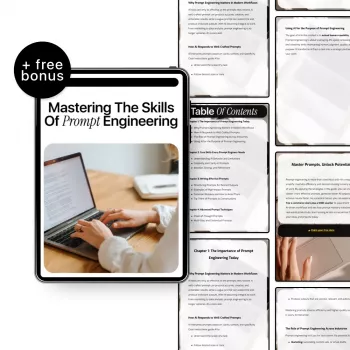
If you want a structured playbook with reusable instruction patterns, templates, and quality checks, start with Mastering the Skills of Prompt Engineering | Practical AI eBook Guide for Modern Workflows & Prompt Engineering Skills Needed Today. It focuses on decomposition, formatting, verification, and repeatable building blocks that hold up under time pressure.
For teams trying to keep work comfortable during heavier computer-based workflows, Hands at Ease: Stop Mouse Pain Fast | Practical eBook for Mouse Hand Strain Reduction, Ergonomic Setup, Pain Relief & Long-Term Comfort pairs well with process improvements by helping reduce the physical strain that can quietly slow output and consistency.
And for operational clarity beyond the screen—where mess and friction also create “hidden rework”—Clear & Cozy: Smart Ideas for Tackling Living Room Clutter – A Practical Guide to Decluttering & Organizing Your Space offers a practical approach to simplifying spaces so routines and focus are easier to maintain.
Focus on goal framing, decomposition, constraint setting, output formatting, verification, and iteration. For example, define acceptance criteria like “150 words max, include 3 bullets, quote the provided source once, and ask 1 clarifying question if a required detail is missing.”
Use reusable task cards, version them with owners and dates, standardize output schemas, and adopt two-pass review (draft then critique/fix). Shared test cases help reveal where instructions break and keep improvements aligned.
Minimize data by using redaction and placeholders, set policy boundaries for disallowed or high-stakes use, and require human review when consequences are significant. Keep lightweight logs for critical workflows so decisions remain auditable.





Leave a comment