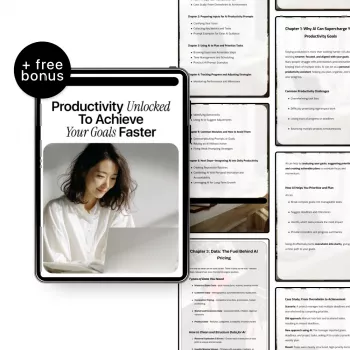
Big goals rarely fail from lack of motivation—they fail from unclear next steps, scattered priorities, and inconsistent follow-through. Productivity Unlocked to Achieve Your Goals Faster (Digital Download) pairs a simple, repeatable productivity framework with ready-to-use AI-assisted exercises so goals turn into weekly plans, daily actions, and measurable progress—without turning your schedule into a second job.
Instead of “work harder,” the system focuses on making the next step obvious, aligning tasks to real capacity, and building small closure habits that prevent mental backlog. If you’ve tried apps, elaborate planners, or ambitious routines that didn’t stick, this approach is designed to be lighter, clearer, and easier to repeat.
Goal-setting research consistently points back to clarity and commitment—specific targets and feedback loops matter. If you want a deeper overview of how goal setting works psychologically, the American Psychological Association (APA) is a solid starting point.
It’s an especially good fit when you’re tired of re-planning from scratch every Monday. The workflow is meant to be reused: the same “translation” method from goal to action, the same weekly rhythm, and the same short daily rituals.
The backbone of the system is a translation process. Each level answers one question, and each step narrows “what matters” into something you can actually do next.
| Level | What it answers | Example output |
|---|---|---|
| Goal | What does success look like? | Finish certification exam prep and pass by May 30 |
| Milestone | What are the major checkpoints? | Complete modules 1–3; take practice tests; review weak areas |
| Weekly plan | What can realistically move forward this week? | 3 study sessions + 1 practice test + review notes |
| Daily execution | What is the next smallest step today? | Open module 2 and complete lesson 2.1 |
That “finish what you start” gap often isn’t grit—it’s friction and ambiguity. For practical perspective on follow-through and completion, Harvard Business Review (HBR) regularly covers the behavioral side of getting work across the finish line.
AI is most useful here as a clarity engine, not a decision-maker. The system uses AI-assisted exercises to reduce the time you spend staring at an empty page or overthinking trade-offs—while keeping final choices firmly in your hands.
Using AI responsibly also means staying mindful about reliability and oversight. If you want a high-level framework for thinking about AI risk and human control, the NIST AI Risk Management Framework is an authoritative reference.
| Day | Primary focus | Suggested structure |
|---|---|---|
| Monday | Plan + first milestone push | Weekly reset + 1–2 focus sprints |
| Tuesday–Thursday | Execution | 2–4 focus sprints + quick daily kickoff/closure |
| Friday | Wrap + prep | Finish key tasks + light review + set Monday’s first action |
| Weekend (optional) | Recovery + light maintenance | Short catch-up or learning block only if helpful |
| Problem | Quick fix | Next action |
|---|---|---|
| Too many priorities | Choose 1 outcome | Schedule first sprint |
| Task feels vague | Break into steps | Do step 1 in 10 minutes |
| Low energy day | Reduce scope | Do the “minimum viable” version |
If you’re ready to implement a lighter, more decisive workflow, start with Productivity Unlocked to Achieve Your Goals Faster (Digital Download) and run the first weekly reset the same day.
Yes. It focuses on a simple workflow (goal → milestones → weekly capacity → daily next actions) instead of adding more tools, so you spend less time organizing and more time executing.
No. The exercises are guided and designed for straightforward outputs you can copy into a single task list or calendar, keeping the system easy to maintain.
Many people notice improvement within a week because the next action becomes clearer and daily priorities shrink to a manageable set. Bigger gains come from repeating weekly reviews and focus sprints over time.





Leave a comment