Customer service is shifting from high-volume, repetitive ticket handling to a blended model where AI manages routine interactions and humans focus on judgment, empathy, and complex resolution. The result isn’t “humans vs. bots”—it’s a new operating rhythm: automation handles the predictable, while agents become investigators, negotiators, and problem-solvers who keep experiences fair, safe, and on-brand.
AI is now embedded in the daily workflow of many support teams—both on the customer-facing side (chatbots/virtual agents) and the agent-facing side (copilots that draft and summarize). That changes what fills an agent’s day and how performance is measured.
| Task area | Before AI support | With AI support | Human edge to strengthen |
|---|---|---|---|
| FAQs & simple requests | High agent time on repetitive questions | Automated handling with bot + self-serve flows | Spot gaps, refine scripts, handle exceptions |
| Case notes & after-call work | Manual summarizing and tagging | Auto-summaries, suggested tags, next steps | Audit accuracy, add nuance, ensure compliance |
| Tone and response writing | Agents draft from scratch | AI drafts, rewrites, and translates | Empathy, brand voice, sensitive situations |
| Troubleshooting | Agents follow static scripts | AI recommends steps based on patterns | Root-cause reasoning when recommendations fail |
| Escalations | Late escalations due to uncertainty | Earlier, better-triaged escalations | Decision-making, ownership, cross-team coordination |
The clearest way to understand disruption is to separate tasks (what gets done) from roles (who owns outcomes). Automation tends to bite hardest where work is predictable and data is structured—think billing lookups, appointment changes, and basic policy questions. But roles that involve judgment, relationship repair, or exceptions still matter—just with new tools and higher expectations.
For labor-market context, the U.S. Bureau of Labor Statistics customer service representative outlook is a useful baseline, while broader workforce implications are tracked by organizations like the OECD.
As support operations modernize, new titles appear—often blending customer empathy with technical and analytical skills. Even when the job title stays the same, these responsibilities increasingly show up inside existing teams.
When routine contacts shrink, the remaining work is more emotionally charged, ambiguous, or high-stakes. That makes certain human skills more valuable—not less.
Many teams use structured risk practices to keep automation safe; the NIST AI Risk Management Framework is a widely referenced approach for thinking about reliability, privacy, and governance.
If your day involves long hours at a desk, protecting your hands and wrists is also part of staying effective—especially as more work shifts to fast-paced chat and documentation. The digital guide Hands at Ease: Stop Mouse Pain Fast focuses on practical ergonomics and habits that support long-term comfort.
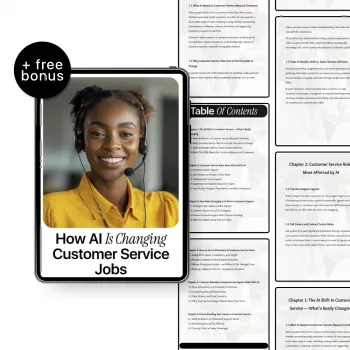
For a focused, career-oriented breakdown of AI’s impact on customer service work—including emerging job titles, skill-building plans, and realistic career moves—see How AI Is Changing Customer Service Jobs: Digital eBook Guide on How AI Affects Customer Service Jobs, Emerging Roles, and Career Strategies.
AI is replacing many repetitive tasks, but humans remain essential for complex, emotional, high-stakes, and exception-driven situations. Roles tend to shift toward escalation handling, oversight of automation, and cross-team problem solving.
Common examples include conversation designer, AI support specialist, AI-augmented knowledge manager, AI quality analyst, and customer insights analyst. Job titles vary by company, but the responsibilities are increasingly consistent across industries.
Focus on escalation mastery, process improvement, data literacy, strong tool fluency with AI copilots, and privacy/compliance awareness. Clear writing and real empathy also become more valuable as remaining cases skew more sensitive and complex.






Leave a comment